Make a New Years resolution to listen to and read along with the Daily Audio Bible. I look forward to joining you all as we read and listen along with the DAB.
Friday, December 31, 2010

Egypt church blast kills seven
(UKPA) – 2 hours ago
 At least seven people have been killed as an explosion went off in front of a Coptic Christian church as worshippers emerged from a New Year's Mass in the Egyptian city of Alexandria.
After the blast, angry Christians emerging from the church clashed with police and stormed a nearby mosque, prompting fights and volleys of stone throwing with Muslims, police and witnesses said - a sign of the sectarian anger that has been arising with greater frequency in Egypt.
Nearly 1,000 Christians were attending the Mass at the Saints Church in the Mediterranean port city of Alexandria, said a priest at the church, Father Mena Adel. The service had just ended, and worshippers were leaving the building when the blast went off, about a half-hour after midnight.
"I was inside the church and heard a huge explosion," Father Adel said. "People's bodies were in flames."
The blast came from a car parked outside the church, but police said they were still investigating whether the car had been rigged with explosives or if a bomb had been placed under it. Witnesses reported seeing the charred chassis of the destroyed car, with the remains of several bodies nearby and dozens wounded.
The Interior Ministry said in a statement that seven people were killed and 24 wounded.
The attack comes at a time of rising sectarian tension in Egypt and the broader region. In November, hundreds of Christians rioted in the capital, Cairom, smashing cars and windows after police violently stopped the construction of a church. The rare outbreak of Christian unrest in the capital left one person dead.
Christians are believed to make up about 10% of Egypt's mainly Muslim population of nearly 80 million people, and they have grown increasingly vocal in complaints about discrimination.
There have been occasional attacks targeting Christians - most notably, in January 2009, seven Christians were killed in a drive-by shooting on a church in southern Egypt during celebrations for the Orthodox Coptic Christmas. The Saints Church in Alexandria targetting early Saturday also came under attack in April 2006, when a man with a knife stabbed worshippers.
At the same time, al Qaida-linked militants have carried out a campaign of attacks against Christians in Iraq, killing 68 in a church siege in October and two more Christians in attacks in Baghdad on Thursday.
(Source)
Racism in Oklahoma City on Christmas Eve
How Black Muslims Celebrated Christmas Eve

Please allow me to say I am against racism from any race and I condemn any white person who is racist. One thing I must point out is Muslims have always sold slaves and still do to this day. Christian groups go and buy these slaves and free them. They help them get citizenship in other countries so they are not captured and resold. Muhammad the founder of Islam not only called Black people many nasty names, the hadiths mention him owning a black slave as well.
Now to the video I notice some things that were said are not only racist but also discriminatory. They mention things about homosexuals now I believe homosexuality to be a sin, but we need to recognize we are all sinners. Our sin is no better or worse then theirs so we shouldn’t show hate towards them. It is a better witness if we treat them as equals and recognize we all have our own sins we once or still struggle with. I will now post some of the hateful comments they made.
"God hates Christmas."
"The white man has set up laws where the faggots and lesbians have rights, and parades."
"The white man is against nature, and we prove that out of scripture."
"The white man is in power now because he is a thief and a murderer."
"God hates America, and he will destroy it."
"The white man has never taught you about God. He lied, and told you he was God."
Now I will say that these guys in no way speak for all of the African Americans so please do not think they speak for the Majority. They do however share a view that most Muslims do and it is very sad. The white race has done many bad things in the past but in every culture there has been slavery it is nothing new. I am against slavery and think it is wrong, now I know some will say wait a minute doesn’t the Bible teach slavery? Well yes and no a servant (slave) in the Bible is a person who works off a debt and after 7 years may chose to stay in which case the Master must allow them. The Bible says to treat them with respect and they were well taken care of so its different then what we consider slavery. Biblical slavery is akin to having a live in maid or butler.
My last point is their blatant abuse of Romans 1:25 I heard a few other verses but couldn’t catch the book or chapter. Since I can prove they abused the text of Romans 1:25 then we can assume they did it with the other scripture texts they mentioned. Now to understand Romans 1:25 we must read the whole context of it. Romans 1 is not addressing any race it is speaking to the whole of human kind, to say its speaking of “white people” is just simply misrepresenting the text. I will post the whole text of Romans 1 so that we can have a clear understanding of it.
Romans 1:1-32 ESV
(1) Paul, a servant of Christ Jesus, called to be an apostle, set apart for the gospel of God,
(2) which he promised beforehand through his prophets in the holy Scriptures,
(3) concerning his Son, who was descended from David according to the flesh
(4) and was declared to be the Son of God in power according to the Spirit of holiness by his resurrection from the dead, Jesus Christ our Lord,
(5) through whom we have received grace and apostleship to bring about the obedience of faith for the sake of his name among all the nations,
(6) including you who are called to belong to Jesus Christ,
(7) To all those in Rome who are loved by God and called to be saints: Grace to you and peace from God our Father and the Lord Jesus Christ.
(8) First, I thank my God through Jesus Christ for all of you, because your faith is proclaimed in all the world.
(9) For God is my witness, whom I serve with my spirit in the gospel of his Son, that without ceasing I mention you
(10) always in my prayers, asking that somehow by God's will I may now at last succeed in coming to you.
(11) For I long to see you, that I may impart to you some spiritual gift to strengthen you--
(12) that is, that we may be mutually encouraged by each other's faith, both yours and mine.
(13) I want you to know, brothers, that I have often intended to come to you (but thus far have been prevented), in order that I may reap some harvest among you as well as among the rest of the Gentiles.
(14) I am under obligation both to Greeks and to barbarians, both to the wise and to the foolish.
(15) So I am eager to preach the gospel to you also who are in Rome.
(16) For I am not ashamed of the gospel, for it is the power of God for salvation to everyone who believes, to the Jew first and also to the Greek.
(17) For in it the righteousness of God is revealed from faith for faith, as it is written, "The righteous shall live by faith."
(18) For the wrath of God is revealed from heaven against all ungodliness and unrighteousness of men, who by their unrighteousness suppress the truth.
(19) For what can be known about God is plain to them, because God has shown it to them.
(20) For his invisible attributes, namely, his eternal power and divine nature, have been clearly perceived, ever since the creation of the world, in the things that have been made. So they are without excuse.
(21) For although they knew God, they did not honor him as God or give thanks to him, but they became futile in their thinking, and their foolish hearts were darkened.
(22) Claiming to be wise, they became fools,
(23) and exchanged the glory of the immortal God for images resembling mortal man and birds and animals and creeping things.
(24) Therefore God gave them up in the lusts of their hearts to impurity, to the dishonoring of their bodies among themselves,
(25) because they exchanged the truth about God for a lie and worshiped and served the creature rather than the Creator, who is blessed forever! Amen.
(26) For this reason God gave them up to dishonorable passions. For their women exchanged natural relations for those that are contrary to nature;
(27) and the men likewise gave up natural relations with women and were consumed with passion for one another, men committing shameless acts with men and receiving in themselves the due penalty for their error.
(28) And since they did not see fit to acknowledge God, God gave them up to a debased mind to do what ought not to be done.
(29) They were filled with all manner of unrighteousness, evil, covetousness, malice. They are full of envy, murder, strife, deceit, maliciousness. They are gossips,
(30) slanderers, haters of God, insolent, haughty, boastful, inventors of evil, disobedient to parents,
(31) foolish, faithless, heartless, ruthless.
(32) Though they know God's decree that those who practice such things deserve to die, they not only do them but give approval to those who practice them.
As you can see it has nothing to do with any race it was a message to all humankind to obey. Well I hope this helps and I pray these Muslims will read about the life of Muhammad, and see how Muslims even today enslave their own race and sell them for labor or sex.
Thanks and God Bless
Brian
Thursday, December 30, 2010
Voice of the Copts' International Human Rights Day Conference
ROBERT SPENCER, PART ONE

ROBERT SPENCER, PART TWO

PAMELA GELLER, PART ONE

PAMELA GELLER, PART TWO

Why I Switched To A Blog
I decided to go with a blog for a few reasons so I thought I would share them with you all. My first reason is that I am tired of web design it takes up to much time. It was taking away from my study time, I would rather study Christianity and write articles. Another reason is that I just think blogs are the way to go they are much simpler but still functional. I do still have my html Bible website and will continue to improve on that but Simply Christian will stay as a blog. One last reason is that I can post my podcasts in an easier format.
God Bless
Brian
Wednesday, December 29, 2010
Five Muslims Arrested in Denmark for Terror Plot
Muhammad said that he would fight people until they become Muslims:
Sahih Muslim 33—It has been narrated on the authority of Abdullah b. Umar that the Messenger of Allah said: I have been commanded to fight against people till they testify that there is no god but Allah, that Muhammad is the messenger of Allah, and they establish prayer, and pay Zakat and if they do it, their blood and property are guaranteed protection on my behalf except when justified by law, and their affairs rest with Allah.
Since Muhammad is Islam's highest moral example, it should come as no surprise that his followers do the same.
COPENHAGEN, Denmark -- Five men planning to shoot as many people as possible in a building housing the newsroom of a paper that published cartoons of the Prophet Muhammad were arrested Wednesday in an operation that halted an imminent attack, intelligence officials said.
Denmark's intelligence service said it arrested four men in two raids in suburbs of the capital, Copenhagen, and seized an automatic weapon, a silencer and ammunition. Swedish police said they arrested a 37-year-old Swedish citizen of Tunisian origin living in Stockholm.
"An imminent terror attack has been foiled," said Jakob Scharf, head of the Danish Security and Intelligence Service, or PET. He described some the suspects as "militant Islamists with relations to international terror networks" and said that more arrests were possible.
PET said it seized a 44-year-old Tunisian, a 29-year-old Lebanese-born man and a 30-year-old who were living in Sweden and had entered Denmark late Tuesday or early Wednesday. The fourth person detained was a 26-year-old Iraqi asylum-seeker living in Copenhagen.
The Danish intelligence service said the group had been planning to enter the building where the Jyllands-Posten daily has its Copenhagen newsdesk and had wanted "to kill as many of the people present as possible." The four men face preliminary charges of attempting to carry out an act of terrorism. They will face a custody hearing Thursday. (Read more.)
Gary Bauer--If Christians Were Treated Like Muslims
Few Americans would deny that Judeo-Christian beliefs and values informed the Founding of this country and that they continue to shape much of American life today. Nor would many of us deny that Americans who embrace Islamic values are a distinct minority here.
I raise these two facts because of an emerging reality: that, in a variety of contexts, American Muslims are treated better than American Christians. That might seem like a bizarre assertion, so think about it in another way: What if the Christians were treated like Muslims in America, and Muslims like Christians?
If Muslims were treated like Christians in America, Muslims would have to tolerate the defamation of their holiest images in our national museums, acts which would be called "artwork" -- and, if particularly provocative, even given taxpayer-funded grants from the National Endowment for the Arts. They would also have to accept Korans being burned and thrown into toilets, which instead of inciting worldwide outrage and retribution would provoke a collective shrug of the shoulders.

If Muslims were treated like Christians, Muslims would be mocked by late night TV talk show hosts and lampooned in crude cartoon parodies. If Christians were treated like Muslims, conspicuous Christianity would be celebrated by our elites as a sign of our diversity and open-mindedness, not disparaged as an embarrassment, a nuisance and a breach of the law.
If Christianity were treated like Islam, our students would be taught a white-washed version of Christian history, with the troubling bits miscast or omitted from textbooks and lesson plans.
If Christianity were treated like Islam, if an evangelical Christian committed an evil act in the name of his faith, he would be portrayed in the media as a deviation from, not a personification of, the Gospel message. Meanwhile, our political and media elites would hasten to assure the public that evangelical Christianity is a religion of peace and that the vast majority of evangelical Christians do not support terrorism.
If Christianity were treated like Islam in America, our president, a professed Christian, would proudly attend Christian-themed dinners and events while skipping Ramadan dinners, not vice versa. And Muslim politicians would go out of their way to assure people that their faith would not affect their policy-making.
If Christianity were treated like Islam, Christmas and Easter would be publicly celebrated for what they are — the signature events of Christianity, marking the birth and the death and Resurrection of Christ — not stripped of all their theological meaning and transformed into secular holidays devoted to crass consumerism.
If Christians were treated like Muslims, NASA would be tasked with reaching out to Christians and recognizing their faith's profound achievements and contributions to science, math and engineering, instead of being told to make Muslims feel good about their rather meager scientific accomplishments.
If Christians were treated like Muslims, the Catholic Church's stances on sex, contraception and human life would be revered as welcome departures from our over-sexed, self-obsessed culture, not condemned as a cause of disease and death in the less-developed world. And if Muslims were treated like Christians, the application of Sharia law around the world would be met not with stony silence but with the outrage it deserves.
If Christians were treated like Muslims in America, amusement parks would celebrate "Christian Family Day," (Six Flags recently celebrated "Muslim Family Day"), and Christians would be asked to embrace, not set aside, their religious convictions at the door when they entered the public square. Meanwhile, Muslim imams, not Christian pastors, would fear hate crimes lawsuits for preaching orthodox views of sexuality and sin.
The notion that American Muslims face discrimination, even to the point of violence, is often posited by America's elites. But that idea evaporates under scrutiny. Remarkably few hate crimes are reported against Muslims (fewer than one-eighth those against Jews). What's more, Muslim immigration to America has risen sharply since September 11, 2001, and Muslims thrive, economically and educationally, once they arrive.
In fact, it is Christians, not Muslims, who increasingly encounter cultural elites who are hostile to their beliefs and values.
Sadly, Christians will never be treated like Muslims by America's elites. Why? Because Christianity can be attacked without fear of retribution. The Christian response to insult and attack -- "to turn the other cheek" -- contradicts the knee-jerk call to violence of many Islamists.
It's also because left-wing elites and radical Islamists are united in the common cause of upending the Judeo-Christian culture and roots of American society.
I’m not in favor of burning the Koran, and I don’t think insulting or defaming symbols of any religion constitutes art. At a time of the year when intolerance for public displays of Christianity is most acute, it is my Christmas wish that Muslims and Christians would be treated equally.
(Source)
Tuesday, December 28, 2010
Radical Nigerian Muslim Group Claims Terror Attacks

JOS, Nigeria -- A radical Muslim sect has claimed responsibility for the Christmas Eve bombings and church attacks in Nigeria that killed at least 38 people, and the group threatened new attacks to avenge local violence against Muslims.
Religious fighting has left more than 500 people dead this year in the deeply divided region where Jos is located. Authorities had already blamed the Boko Haram group for some of the deaths Friday.
"Therefore we will continue with our attacks on disbelievers and their allies and all those who help them," said the group, which also said it has taken on a new name.
Two bombs went off near a large market in Jos where people were doing last-minute Christmas shopping Friday. A third hit a mainly Christian area of Jos, while the fourth was near a road that leads to the city's main mosque. Officials said at least 32 died from the blasts.
That same day, two churches were attacked in the northern city of Maiduguri about 320 miles away, killing at least six people. Authorities said a Baptist pastor and two choir members preparing for a late-night carol service were among the victims.
The radical Muslim sect was thought to be vanquished in 2009. Nigeria's military crushed its mosque into concrete shards, and its leader was arrested and died in police custody.
But now, a year later, Maiduguri and surrounding villages again live in fear of the group, whose members have assassinated police and local leaders and engineered a massive prison break, officials say. Western diplomats worry that the sect is catching the attention of Al Qaeda's North Africa branch. It remains unclear what, if any, formal links Al Qaeda in the Islamic Maghreb has made with the sect.
Boko Haram says it has changed it name to: "The organization of followers of the teachings of Prophet Muhammad and champions of Islam and holy wars."
Nigeria, a country of 150 million people, is almost evenly split between Muslims in the north and the predominantly Christian south. The blasts happened in central Nigeria, in the nation's "middle belt," where dozens of ethnic groups vie for control of fertile lands.
The violence, though fractured across religious lines, often has more to do with local politics, economics and rights to grazing lands. The government of Plateau state, where Jos is the capital, is controlled by Christian politicians who have blocked Muslims from being legally recognized as citizens. That has locked many out of prized government jobs in a region where the tourism industry and tin mining have collapsed in the last decades.
(Source)
Los Angeles City Council Passes Resolution Opposing "Islamophobia"
WITHOUT serious debate or examination, the Los Angeles City Council recently passed a resolution that opposes "Islamophobia" and "repudiates" random acts of violence against Muslims.
This admittedly ceremonial resolution apparently accepts the premise that residents of the city commit acts of hate against Muslims so often that it warrants an official resolution from city leaders condemning and repudiating these acts. Is this really the case?
According to the latest hate crime report from the Los Angeles County Commission on Human Relations, 88 percent of all religiously based hate crimes in 2009 were against Jews. Hate crimes that targeted Muslims (3 percent) ranked slightly above those directed at Scientologists (1 percent). In fact, the commission found that attacks against Christians (8 percent) outnumbered attacks against Muslims.
In any case, the actual number of reported hate crimes based on religion is quite small. In a county that has more than 10 million highly diverse residents, only a total of 131 crimes based on religion took place in all of 2009. Of course, this in no way takes away from the emotional or physical harm that each and every one of these attacks causes.
Since only 3 percent of 131 hate crimes during 2009 was directed against Muslims, it's difficult to understand why city leaders would pass a resolution that zeroes in on the category that has the next-to-lowest numbers recorded by the County's Human Relations
Commission.
It appears that the City Council simply took information provided by an advocacy group, one that's hardly unbiased, and uncritically spat out a resolution opposing "Islamophobia" and "random acts of violence against Muslim-Americans."
This begs the question: Except for some Islam-hating cretins with sub-zero levels of intelligence, exactly who is in favor of random acts of violence against Muslims?
The term "Islamophobia" has crept into popular use, drummed into our consciousness by a sensationalized Time magazine cover story, and activists who exaggerate anti-Islamic bias for the causes they espouse. The term dominated the often angry debates that swirled around the plan to build a mosque 600 feet from Ground Zero in New York. While there are extremists at both the left and right ends of the political spectrum, the issues surrounding this controversial building project are far more complex than anti-Islamic bigotry.
Factually, there is no alarming number of attacks against Muslim-Americans. According to the FBI, the largest number of recorded hate crimes against Muslim-Americans took place in 2001. That year the number dramatically escalated from only 28 in 2000 to 481 in 2001 - the year that young Muslim men drove planes into the World Trade Center, the Pentagon and a field outside of Shanksville, Pa., murdering 3,000 innocent Americans in the name of Islam.
Prior to the City Council resolution, the Muslim Public Affairs Council released a statement expressing skepticism about tactics used by law enforcement among Muslim-Americans. The statement referenced the recent and troubling incident where the FBI says a young Somali man in Portland, Ore., plotted to blow up a public Christmas tree lighting ceremony. The MPAC statement also mentioned a similar case in Baltimore, where the FBI says a Muslim convert planned to bomb a military recruitment center in that city.
This statement from MPAC is in effect a thinly veiled claim that government agents entrapped these wannabe-terrorists. But as we have discovered, this young man's dilemma in Portland was hardly entrapment - in fact, as we know, his father called the FBI to let them know about his son's growing jihadist views. Nonetheless, the claims from MPAC and other Islamic activists groups were taken seriously enough to cause a response from the nation's attorney general. Eric Holder gave a 20-minute speech in San Francisco at the annual dinner event of Muslim Advocates, an Islamic civil rights group.
Speaking forcefully, Holder told the group, "These types of operations have proven to be an essential law enforcement tool in uncovering and preventing potential terror attacks .... Those who characterize the FBI's activities as `entrapment' simply do not have their facts straight - or do not have a full understanding of the law."
But of course, the advocacy of causes may or may not take facts into account, nor always have a good understanding of the law.
The Muslim Public Affairs Council held a recent conference at the Bonaventure Hotel under the banner of "The Struggle for America's Conscience." Throughout the day, the rising incidence of home-grown terrorist plots, from Baltimore to Portland, were blamed on improper law enforcement strategies or the presence of "Islamophobia."
Sadly, under the leadership of its director, Salam Al-Marayati, MPAC has a long record of defending extremist groups and criticizing America's counterterrorism efforts. In 2003 MPAC issued a paper that advocated removing Hezbollah, Islamic Jihad, and Hamas from the government's official list of terrorist groups.
This city's leaders should not be so transparently susceptible to the lobbying efforts of activists and advocates. In this case, they have passed a resolution that would lead many to think America's Muslims are under attack nationally and that here in Los Angeles acts of hate are out of control. This might serve the advocates' agenda, but it ill-serves the interests of the people of Los Angeles.
(Source)
Monday, December 27, 2010
Spanish Prosecutor Throws out Muslim Student's "Ham" Complaint
A prosecutor has thrown out a complaint made by a Muslim family against a geography teacher who mentioned pork in their son’s class.
The teacher was explaining how cold climate in Granada highlands helps to preserve local Serrano ham.
The Children’s Prosecutor of Algeciras, Juan Cisneros, described the complaining pupil’s attitude as ‘abusive, sectarian, capricious and inadmissible’ and ordered the denouncement to be archived.
He said: “There is not even the minimal indication of any type of crime.”
The prosecutor went on to condemn the media storm created by the pupil’s parents and their opponents. He described the public’s interest in the case as ‘worrying’.(Source)
I am glad the prosecutor wouldn’t buy into this case. It shows the length Muslims will go to try to remove freedom of speech from or western civilizations. The part the saddens me the most is the fact that the media made it a big deal. I see it as a way to try to pacify the Muslims thinking they wont hard us, though they will anyways. We need to show them we won’t be their Dhimmies.
Sunday, December 26, 2010
Pope Denounces Christmas Attacks, Calls for Peaceful Resolution
 Pope Denounces Christmas Attacks, Calls for Peaceful Resolution
Read more: http://www.foxnews.com/world/2010/12/26/pope-denounces-christmas-attacks-calls-peaceful-resolution/#ixzz19FLZDPjt
This is the same Pope who kissed the Quran looks like that didn't help. I wonder when the world will wake up and see how dangerous Islam and Atheism have become?
Friday, December 24, 2010
The Birth of Jesus Christ
Matthew 1:18-2:6 (English Standard Version)
The Birth of Jesus Christ
18Now the birth of Jesus Christ took place in this way. When his mother Mary had been betrothed to Joseph, before they came together she was found to be with child from the Holy Spirit. 19And her husband Joseph, being a just man and unwilling to put her to shame, resolved to divorce her quietly. 20But as he considered these things, behold, an angel of the Lord appeared to him in a dream, saying, "Joseph, son of David, do not fear to take Mary as your wife, for that which is conceived in her is from the Holy Spirit. 21She will bear a son, and you shall call his name Jesus, for he will save his people from their sins." 22 All this took place to fulfill what the Lord had spoken by the prophet:23 "Behold, the virgin shall conceive and bear a son,
and they shall call his name Immanuel"
(which means, God with us). 24When Joseph woke from sleep, he did as the angel of the Lord commanded him: he took his wife, 25but knew her not until she had given birth to a son. And he called his name Jesus.
Matthew 2
The Visit of the Wise Men
1Now after Jesus was born in Bethlehem of Judea in the days of Herod the king, behold, wise men from the east came to Jerusalem, 2saying, "Where is he who has been born king of the Jews? For we saw his star when it rose and have come to worship him." 3When Herod the king heard this, he was troubled, and all Jerusalem with him; 4and assembling all the chief priests and scribes of the people, he inquired of them where the Christ was to be born. 5They told him, "In Bethlehem of Judea, for so it is written by the prophet:
6 "'And you, O Bethlehem, in the land of Judah,
are by no means least among the rulers of Judah;
for from you shall come a ruler
who will shepherd my people Israel.'"
Luke 2:1-21 (English Standard Version)
The Birth of Jesus Christ
1In those days a decree went out from Caesar Augustus that all the world should be registered. 2This was the first registration when Quirinius was governor of Syria. 3And all went to be registered, each to his own town. 4And Joseph also went up from Galilee, from the town of Nazareth, to Judea, to the city of David, which is called Bethlehem, because he was of the house and lineage of David, 5to be registered with Mary, his betrothed, who was with child. 6And while they were there, the time came for her to give birth. 7And she gave birth to her firstborn son and wrapped him in swaddling cloths and laid him in a manger, because there was no place for them in the inn.The Shepherds and the Angels
8And in the same region there were shepherds out in the field, keeping watch over their flock by night.9And an angel of the Lord appeared to them, and the glory of the Lord shone around them, and they were filled with fear. 10And the angel said to them, "Fear not, for behold, I bring you good news of great joy that will be for all the people. 11For unto you is born this day in the city of David a Savior, who is Christ the Lord. 12And this will be a sign for you: you will find a baby wrapped in swaddling cloths and lying in a manger." 13And suddenly there was with the angel a multitude of the heavenly host praising God and saying,14 "Glory to God in the highest,
and on earth peace among those with whom he is pleased!"
15When the angels went away from them into heaven, the shepherds said to one another, "Let us go over to Bethlehem and see this thing that has happened, which the Lord has made known to us." 16And they went with haste and found Mary and Joseph, and the baby lying in a manger. 17And when they saw it, they made known the saying that had been told them concerning this child. 18And all who heard it wondered at what the shepherds told them. 19But Mary treasured up all these things, pondering them in her heart. 20And the shepherds returned, glorifying and praising God for all they had heard and seen, as it had been told them.
21And at the end of eight days, when he was circumcised, he was called Jesus, the name given by the angel before he was conceived in the womb.
Moved To Blog
Well I decided to move the site to a blog so that it would be more simple for me to write articles. I will be working on a blogger theme soon but this one will be good for now so God Bless and have a Merry Christmas.
My Thoughts on Bible Borrowing from Mythology Part 1
 I try not to write much because it’s a pain for me but I want to speak my peace about it. Some people may not agree with my conclusions but I feel they are very sound and make sense. We must remember similarity doesn’t always equal borrowing or even a common source. I would also add that while we look at minor similarities, we must also look at the major differences.
Now that I have some rules established I would like to begin with my thoughts on this subject. One thing we must think about is that these similar stories support the Bible since we believe after the flood and the tower of babel men spread all over the world. As they spread out they carried these stories with them but unfortunately some let pagan myths creep in. I believe when God spoke to Moses he gave him the correct stories of Creation and Global Flood.
As I look at Genesis it is superior in every way and it records these things as historical facts. Now as I said before we must also take a look at the Major differences in these stories. Anyone can find similarities in any stories fictional or non fictional alike this does not mean these writers copied from each other, or even borrowed for that matter. I will now point out one major difference that makes these similarities of little importance.
The biggest difference in these accounts is most if not all record not one but many gods fighting and so things like creation or the flood occurred. I see these major differences and I can understand why most Scholars reject these accusations of copying or borrowing even. Like I stated before similarities can be found in almost anything. An example would be I wear glasses because I have bad eye sight so does that mean that a person who has bad eye sight and wears glasses copied or borrowed from me? The answer is simply NO so we must apply these same standards to this topic as well.
These are just a few of my observations but I will blog more on it in a few days after the Holidays.
God Bless
Brian
In E-Mails, NYC Pushes for Mosque Near Ground Zero
 NEW YORK -- Mayor Michael Bloomberg's office worked behind the scenes to help the organizers of a mosque and community center near ground zero, intervening with city administrators to get a temporary prayer service permit and having an official ghostwrite a letter to community leaders.
E-mails released by the city Thursday document the cooperation between Bloomberg's Community Affairs Unit and the Cordoba Initiative, even as a furor erupted this year over the center's proposed existence two blocks north of ground zero. The city released the documents in response to a public-records lawsuit by Judicial Watch, a conservative group.
Bloomberg's spokesman said the city has extended similar help to other religious groups. But Judicial Watch says the e-mails show the city government went too far with its assistance.
Bloomberg has been one of the strongest supporters of the project, which drew huge protests on both sides in the months before the ninth anniversary of the Sept. 11 attacks. Opponents argued that locating a mosque so close to the attack site is insensitive to the victims' memories. Bloomberg and other supporters have said allowing the center to be built reflects American values of tolerance and religious freedom.
The city's help was no different from the assistance it gives other organizations, Bloomberg spokesman Stu Loeser said.
"It is nothing out of the ordinary. This is what the Community Affairs Unit does," he said, citing assistance the mayor's office gave Roman Catholic officials in composing a letter to community boards asking for their help with a papal visit and in rushing through a permit for a temporary hut erected for a Jewish holiday.
In May, Nazli Parvizi, the head of the city's community affairs unit, composed a 500-word letter to send to Community Board 1, an advisory council in lower Manhattan, about the mosque project. The draft of Parvizi's letter describes the center as a "wonderful expression of our religion" and laments "media distortion" of the project. The letter in e-mails was signed by Daisy Khan, the wife of Imam Feisal Abdul Rauf, the man behind the project.
In August, Bloomberg cited the community board's support in a speech endorsing the project.
In January the Cordoba Initiative asked Bloomberg's commissioner of immigrant affairs, Fatima Shama, for help getting a temporary permit to hold Friday worship services at the proposed site. The city had approved permits for previous weeks, and the group believed the omission was due to a clerical error.
Shama responded a few hours later, saying the problem had been fixed.
As public anger over the mosque began to spread in May, supporters turned to the city for advice.
"Is there a good time to chat tomorrow. We need some guidance on how to tackle the opposition," Khan wrote to Shama.
The e-mails also document donations of $300 from the Cordoba Initiative and $150 from the American Society for Muslim Advancement, a sister group, to help pay for an Aug. 24, 2009, dinner celebrating the holy Islamic month of Ramadan at the mayor's residence.
It was at that event that Rauf first told Bloomberg about his plans for the Islamic center, and the mayor responded that it sounded like a good idea, Loeser said.
Loeser said the donations did not influence the mayor's support of the project.
The center's developers envision a 13- to 15-story facility with a health club, a playground, a day care center, an auditorium, a Sept. 11 memorial and a prayer room for 2,000 worshippers. The developer of the site has said groundbreaking is about three years away.
Judicial Watch President Tom Fitton said the documents show the city was an active proponent of the project.
"The mayor's office was at the beck and call of the ground zero mosque folks," Fitton said. "He obviously feels strongly about it, but he shouldn't turn the taxpayers of New York into advocates for this group."
The American Center for Law and Justice, which has sued the city to try to stop the Islamic center, said Bloomberg continues "to promote and advance a project that offends most New Yorkers and most Americans." A CBS News poll in August said about 71 percent of Americans oppose the project.
On Thursday the Cordoba Initiative said the Islamic center would bring economic development to lower Manhattan, and it thanked the Bloomberg administration for its help.
"I don't think they've acted improperly at all," said Leyla Turkkan, a spokeswoman for the project.
Read more: http://www.foxnews.com/us/2010/12/24/e-mails-nyc-pushes-mosque-near-ground-zero/#ixzz193ipaxhL
Wednesday, December 22, 2010
Is Genesis stolen from Babylonian myths?
In some Skeptical circles, it is still fashionable to make the claim that the creation account of Genesis was in some sense borrowed from the Babylonian creation account,Enuma Elish (hereafter EE; those who hold this view are hereafter "EE proponents"). I have used a turn of phrase suggesting that the argument isn't held in all Skeptical circles -- the latest fad in this regard is to attribute most of the borrowing from Egyptian sources, as Greenberg does in 101 Myths of the Bible (though he posits some Babylonian influence on stories like the Flood and Cain and Abel).
Still, and it is thus a good idea to run through some of the arguments. My own perception is that we would expect some similarities in EE and Genesis -- and in other creation accounts as well -- if they all derived from a common source.
Some of the differences in the accounts are basic:
- EE records "successive generations of gods and goddesses" who are subject to typical weaknesses such as hunger, thirst, and sex drive; Genesis records but one God, though He had company of unspecified nature (Gen. 1:26), with no such weaknesses.
- The EE is a creation account to some extent, but most of it is devoted to describing a battle between the god Marduk (the "creator" as such) and Tiamat the goddess (who ends up being the raw material of creation), and to other non-creation issues, so that after tally, only about a third of it is on the subject of creation.
- EE played a political and cultic role in the Babylonian religion and explained Marduk's rise to chief god of Babylon; Genesis does not mention Israel, Jerusalem, or the Temple, and served no cultic function [Sarna, Understanding Genesis, 9; I would suggest that this points to the Genesis account being more original].
But, let us move to detail. Our foundational source for this essay is Alexander Heidel's classic work, The Babylonian Genesis. (U. of Chicago Press, 1942) We will address relevant points in outline form, following the order of Genesis as required.
Gen. 1:1 In the beginning God created the heaven and the earth.
All stories must start somewhere, and the ways in which Genesis differs from EE at the very beginning is quite significant. Genesis starts us "in the beginning", at a time-point which suggests nothing before.
But EE and other Babylonian creation accounts start with words like, "on the day that" or "when" -- which do not specify a beginning. The Hebrew word here means "at the first" (Numbers 15:20 "Ye shall offer up a cake of the first of your dough for an heave offering..."); the matching Hebrew word for the Babylonian record is not what is used. This feature "finds no parallels in the cosmogonies" of Babylon.
1:2 And the earth was without form, and void; and darkness was upon the face of the deep. And the Spirit of God moved upon the face of the waters.
EE also supposes a watery chaos in place, and this is where EE proponents had their biggest party. The word for "deep" here is tehowm, and EE proponents leapt upon the similarity of this word to the name of the Babylonia goddess Tiamat.
In the EE, Tiamat was the water-goddess who was slain by Marduk and used to make the watery chaos. It was supposed that tehom was linguistically derived from Tiamat, thus proving borrowing.
Substantial differences render this unlikely. Tiamat was only one of two water-deities involved in this story; the other was the water-god Apsu. Tiamat was salty water; Apsu was fresh water. Apsu, at any rate, has no parallel in Genesis at all, and thetehom is inanimate.
Of more import, the linguistic connection supposed by the critics could, if anything, only have gone in the opposite direction. The words are indeed from the same root (as are indeed, as Heidel points out, the German word for "blessed" (selig) and the English word "silly"), but Heidel demonstrates at length that for tehowm to be derived from Tiamat is "grammatically impossible" based on the rules of Hebrew as we know them. The Hebrew tehowm has a masculine ending; Tiamat is feminine.
A loan word from Babylonian to Hebrew would retain the feminine; we would not expect tehowm but tiama or teama. Hebrew would also not add the H unless it were found in the original word (i.e., it would have to have been Tihamat). Heidel's conclusion is that the two words probably go back to "a common Semitic form," rather than that one was derived from the other [100].
I can mention an observation of my own here. If Genesis was an effort to "clean up" the Babylonian myth for Hebrews, it wouldn't make a lot of sense to use a word with such a clear linguistic connection to the name of a Babylonian goddess. Genesis could simply have referred to the "waters" as it does later on.
It is also worth mentioning a special connection that was made by EE proponents who suggested that the EE represented a symbolic form of the rainy season and flood cycle and Babylon, and that this was proof of borrowing by the Hebrews, because they kept this form in spite of living in arid Judea. Heidel responds by noting that the EE proponents hadn't studied Babylonian climate very well -- the rainy season and the flood season there come at entirely different times of the year; if indeed there is a "rainy season" as the area gets only about 6 inches of precipitation a year. [98]
1:3-5 And God said, Let there be light: and there was light. And God saw the light, that it was good: and God divided the light from the darkness. And God called the light Day, and the darkness he called Night...
Like EE, Genesis says that light was around even before the creation of the luminaries. A difference here is that in EE, the light was an attribute of deity, whereas here, it is a creation of the deity.
1:6-10 And God said, Let there be a firmament in the midst of the waters, and let it divide the waters from the waters. And God made the firmament, and divided the waters which were under the firmament from the waters which were above the firmament: and it was so. And God called the firmament Heaven. And the evening and the morning were the second day. And God said, Let the waters under the heaven be gathered together unto one place, and let the dry land appear: and it was so. And God called the dry land Earth; and the gathering together of the waters called he Seas: and God saw that it was good.
The dividing of substances is a commonality in several creation accounts across cultures -- it is found in Egypt, Phoenicia, and India as well, though the elements in question may differ (water, an egg, etc.)[114-115]. The point being, that it makes better sense to postulate an ancient common source than to suggest borrowing.
1:11 And God said, Let the earth bring forth grass, the herb yielding seed, and the fruit tree yielding fruit after his kind, whose seed is in itself, upon the earth: and it was so....(1:19-25)
This, and the creation of animals, has no parallel known in the EE. It is possible that the creation of vegetation and animals was recorded on a part of the EE that was lost; Heidel reports a gap in the record, but doesn't suppose that there was much room for such a report, which would have to fall between astronomical data and a plea from the gods [117].
I would suggest that it is easier to imagine the Babylonians dropping this element rather than Genesis adding it.
1:14-18 And God said, Let there be lights in the firmament of the heaven to divide the day from the night; and let them be for signs, and for seasons, and for days, and years: And let them be for lights in the firmament of the heaven to give light upon the earth: and it was so. And God made two great lights; the greater light to rule the day, and the lesser light to rule the night: he made the stars also. And God set them in the firmament of the heaven to give light upon the earth, And to rule over the day and over the night, and to divide the light from the darkness: and God saw that it was good.
Both EE and Genesis record the creation of the luminaries, and in both cases say that they were for light and time-keeping purposes -- no surprise, since all cultures worldwide use the luminaries for the same purpose. The Babylonian account does take a more "astrological" view, however, as it makes a point of the creation of the zodiac and the partitioning of constellations within.
Genesis also reports the creation of luminaries in the reverse order of the EE (which lists the stars first). Genesis is also missing EE's reference to gates at the east and the west of the sky through which the sun and moon pass [116].
One is constrained to ask how critics, who suppose the Hebrews to believe in a solid sky and a flat earth, think that this little tidbit was left out of a "copycat" story.
1:26-30 And God said, Let us make man in our image, after our likeness: and let them have dominion over the fish of the sea, and over the fowl of the air, and over the cattle, and over all the earth, and over every creeping thing that creepeth upon the earth. So God created man in his own image, in the image of God created he him; male and female created he them. And God blessed them, and God said unto them, Be fruitful, and multiply, and replenish the earth, and subdue it: and have dominion over the fish of the sea, and over the fowl of the air, and over every living thing that moveth upon the earth. And God said, Behold, I have given you every herb bearing seed, which is upon the face of all the earth, and every tree, in the which is the fruit of a tree yielding seed; to you it shall be for meat. And to every beast of the earth, and to every fowl of the air, and to every thing that creepeth upon the earth, wherein there is life, I have given every green herb for meat: and it was so.
With this we come to perhaps the most significant difference between EE and Genesis. The creation of man at first blush seems very similar -- God creates man from dust, and imputes with life with His breath or spirit; Marduk gives Ea (another god) a plan to create man, leading Ea to go and kill Kingu (another god yet) and mix his blood with dirt to make man.
The basic principles of dirt and divine substance appears in both accounts, but few would deny that Genesis is more sophisticated -- leaving us again to wonder whether positing a "clean up" job is more plausible.

A larger difference, however, emerges in terms of man'spurpose. In the EE, man is created because Marduk was prompted in his heart to "create ingenious things". Once that is done, man's purpose is to serve the gods, build their temples, and make sacrifices to them. Men are, essentially, the gods' boot-polishers.
But in Genesis, man is not a servant to God; he is God's agent. For more on this, particularly image-language, see Chapter 1 of my book,  The Mormon Defenders. There is great significance in the point that in other societies than Israel, the "image" language is applied only to rulers. Socially it is more likely that this designation was taken from all men by power-hungry rulers than that it wasexpanded by the Hebrews to include all men.
Finally:
Genesis 2:2-3 And on the seventh day God ended his work which he had made; and he rested on the seventh day from all his work which he had made. And God blessed the seventh day, and sanctified it: because that in it he had rested from all his work which God created and made.
The gods of the EE "rested" also, after a fashion -- they threw a big party, one that takes up almost two tablets of the EE out of seven, in which Marduk is honored. In that context it is worth noting that some saw a connection between Genesis' 7 daysand the EE's 7 tablets, but as noted, the creation takes up only four of EE's tablets, and the EE does not lay out a seven-day pattern of creation.
Our summary conclusion: The views of EE proponents simply do not correspond with the data -- and thus it is not surprising that most borrowing-proponents have sought their parallels elsewhere. (For more on those other stories, see the series here by the Christian ThinkTank.)
-JPH
Should Genesis be taken literally?
Photo Dr Clifford Wilson
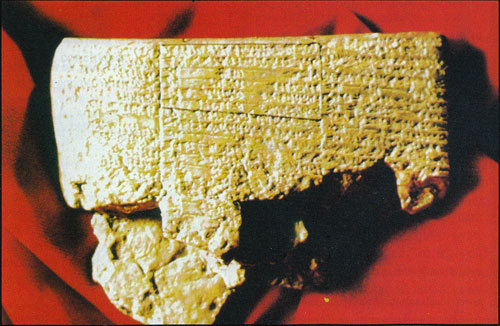
A Babylonian tablet fragment found at Nippur, an ancient Babylonian site in the same general location that Abraham came from. The area outlined in black is a record about the Flood. There are more than 300 known records of the Flood world-wide, with about 30 of them in writing. Some are remarkably close in their details to the original—the biblical account.
Creationists are often accused of believing that the whole Bible should be taken literally. This is not so! Rather, the key to a correct understanding of any part of the Bible is to ascertain the intention of the author of the portion or book under discussion. This is not as difficult as it may seem, as the Bible obviously contains:
- Poetry—as in the Psalms, where the repetition or parallelism of ideas is in accordance with Hebrew ideas of poetry, without the rhyme (parallelism of sound) and metre (parallelism of time) that are important parts of traditional English poetry. This, by the way, is the reason why the Psalms can be translated into other languages and still retain most of their literary appeal and poetic piquancy, while the elements of rhyme and metre are usually lost when traditional Western poetry is translated into other languages.
- Parables—as in many of the sayings of Jesus, such as the parable of the sower (Matthew 13:3–23), which Jesus Himself clearly states to be a parable and about which He gives meanings for the various items, such as the seed and the soil.
- Prophecy—as in the books of the last section of the Old Testament (Isaiah to Malachi).
- Letters—as in the New Testament epistles written by Paul, Peter, John, and others.
- Biography—as in the Gospels.
- Autobiography/testimony—as in the book of Acts where the author, Luke, after narrating the Apostle Paul’s conversion on the road to Damascus as a historical fact (Acts 9:1–19), then describes two further occasions when Paul included this conversion experience as part of his own personal testimony (Acts 22:1–21; 26:1–22).
- Authentic historical facts—as in the books of 1 and 2 Kings, etc.
So the author’s intention with respect to any book of the Bible is usually quite clear from the style and the content. Who then was the author of Genesis, and what intention is revealed by his style and the content of what he wrote?
The author
The Lord Jesus Himself and the Gospel writers said that the Law was given by Moses (Mark 10:3; Luke 24:27; John 1:17), and the uniform tradition of the Jewish scribes and early Christian fathers, and the conclusion of conservative scholars to the present day, is that Genesis was written by Moses. This does not preclude the possibility that Moses had access to patriarchal records, preserved by being written on clay tablets and handed down from father to son via the line of Adam–Seth–Noah–Shem–Abraham–Isaac–Jacob, etc., as there are 11 verses in Genesis which read, ‘These are the generations [Hebrew: toledoth= ‘origins’ or by extension ‘record of the origins’] of … .’1 As these statements all come after the events they describe, and the events recorded in each division all took place before rather than after the death of the individuals so named, they may very well be subscripts or closing signatures, i.e. colophons, rather than superscripts or headings. If this is so, the most likely explanation of them is that Adam, Noah, Shem, and the others each wrote down an account of the events which occurred in his lifetime, and Moses, under the guidance of the Holy Spirit, selected and compiled these, along with his own comments, into the book we now know as Genesis2 (see also Did Moses really write Genesis?).
Chapters 12–50 of Genesis were very clearly written as authentic history, as they describe the lives of Abraham, Isaac, Jacob, and his 12 sons who were the ancestral heads of the 12 tribes of Israel. The Jewish people, from earliest biblical times to the present day, have always regarded this portion of Genesis as the true record of their nation’s history.
So what about the first 11 chapters of Genesis, which are our main concern, as these are the ones that have incurred the most criticism from modern scholars, scientists, and sceptics?
Genesis 1–11
Are any of these chapters poetry?
To answer this question we need to examine in a little more depth just what is involved in the parallelism of ideas that constitutes Hebrew poetry.
Let us consider Psalm 1:1, which reads as follows: ‘Blessed is the man that walks not in the counsel of the wicked, nor stands in the way of sinners, nor sits in the seat of scoffers.’ Here we see triple parallelism in the nouns and verbs used (reading downwards in the following scheme):
walks
counsel
wicked
stands
way
sinners
sits
seat
scoffers
As well as this overt parallelism, there is also a covert or subtle progression of meaning. In the first column, ‘walks’ suggests short-term acquaintance, ‘stands’ implies readiness to discuss, and ‘sits’ speaks of long-term involvement. In the second column, ‘counsel’ betokens general advice, ‘way’ indicates a chosen course of action, and ‘seat’ signifies a set condition of mind. In the third column, ‘wicked’ describes the ungodly, ‘sinner’ characterizes the actively wicked, and ‘scoffers’ portrays the contemptuously wicked.
Other types of Hebrew poetry include contrastive parallelism, as in Proverbs 27:6, ‘Faithful are the wounds of a friend, but the kisses of an enemy are deceitful’, and completive parallelism, as in Psalm 46:1, ‘God is our refuge and strength, a very present help in time of need.’3.
Are any of the first 11 chapters of Genesis poetry?
Answer: No, because these chapters do not contain information or invocation in any of the forms of Hebrew poetry, in either overt or covert form.
And so we return to our question. Are any of the first 11 chapters of Genesis poetry?
Answer: No, because these chapters do not contain information or invocation in any of the forms of Hebrew poetry, in either overt or covert form, and because Hebrew scholars of substance are agreed that this is so (see below).
Note: There certainly is repetition in Genesis chapter 1, e.g. ‘And God said …’ occurs 10 times; ‘and God saw that it was good/very good’ seven times; ‘after his/their kind’ 10 times; ‘And the evening and the morning were the … day’ six times. However, these repetitions have none of the poetic forms discussed above; rather they are statements of fact and thus a record of what happened, and possibly for emphasis—to indicate the importance of the words repeated.
Are any of these chapters parables?
No, because when Jesus told a parable He either said it was a parable, or He introduced it with a simile, so making it plain to the hearers that it was a parable, as on the many occasions when He said, ‘The kingdom of heaven is like … .’ No such claim is made or style used by the author of Genesis 1–11.
Are any of these chapters prophecy?
Photo Dr Clifford Wilson
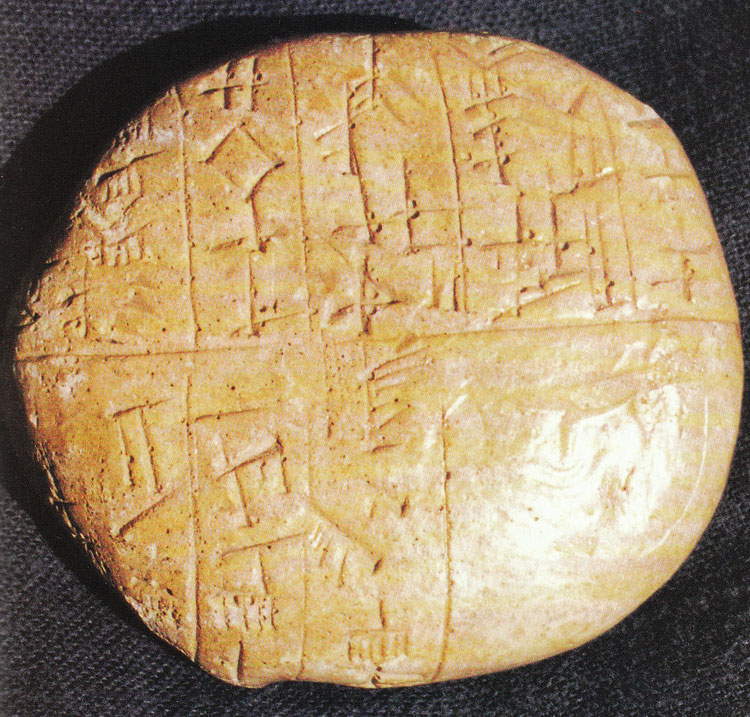
A creation tablet found at Ebla in Syria and dating to the third millennium BC. It ascribes the great works of creation to one great being, ‘Lugal’, literally ‘the Great One’. It shows that both the creation story and the art of writing were well known to man up to 1,000 years before the time of Moses. It further shows that the liberal idea that the early chapters of Genesis were first put into writing hundreds of years after the time of Solomon is clearly fallacious.
Not in their full context, although two promises of God are prophetic in the sense that their fulfilment would be seen in the future. One of these is Genesis 3:15, which was the pronouncement by God to the serpent (Satan) in metaphorical form: ‘And I will put enmity Between you and the woman, And between your seed and her seed; He shall bruise you on the head, And you shall bruise him on the heel.’ (NASB). Many have interpreted the ‘seed’ in this verse as the Messiah, including most evangelicals and even the Jewish Targums4 hence the Talmudic expression ‘heels of the Messiah’5. The Messiah would suffer wounds to His feet (on the Cross), but would completely destroy Satan’s power. This verse also hints at the virginal conception, as the Messiah is called the seed of the woman, contrary to the normal biblical practice of naming the father rather than the mother of a child (cf. Genesis chapters 5 and 11, 1 Chronicles chapters 1–9, Matthew chapter 1, Luke 3:23–38).
The other is Genesis 8:21–22 and 9:11–17,
‘And the LORD said in His heart, I will not again curse the ground any more for man’s sake … and the waters shall no more become a flood to destroy all flesh.’
Are any of these chapters letters, biography, orautobiography/personal testimony?
This is where we need to consider some of the subscripts mentioned above.
If Adam knew the events of Creation Days 1–6, they must have been revealed to him by God, as Adam was not made until Day 6, and so he could have known them only if God had told him. This view is reinforced by the words, ‘These are the generations of [NIV: ‘This is the account of’] the heavens and of the earth when they were created …’ in Genesis 2:4a. The details of Day 7, the rest day, are included before this in Genesis 2:2–3, thereby completing (as we might expect) the record of a full seven-day week, before this subscript or closing signature appears.
Then follow the events of Genesis 2:4b–5:1a. This section tells us about Adam, his wife Eve, and their sons, and reads very much like a personal account of what Adam knew, saw, and experienced concerning the Garden of Eden, and the creation of Eve (chapter 2), their rebellion against God (chapter 3), and the deeds of their descendants (chapter 4 to 5:1), albeit written in the third person6. This section ends with the words, ‘This is the book of the generations of Adam.’
Is it feasible that Adam could have written Genesis 1:1–2:4a as the result of his pre-Fall conversation with God, and Genesis 2:4b–5:1 as the record of his own experiences? There is no problem concerning his ability to have done so. Adam was created a mature man, endowed with all the DNA, knowledge and skill he needed to perform all the tasks assigned him by God. No cave-man he! Adam knew enough horticulture ‘to dress and to keep’ the Garden of Eden (Genesis 2:15), and ample intelligence to recognize and name the distinct kinds of animals (Genesis 2:19). He (and Eve) could converse with God without ever having learned an alphabet, and there is no reason to suppose that he was not fully skilled in writing also7.
Supposed contradictions
What about the supposed contradictions between the order of events in Genesis chapter 2 and the order given in chapter 1?
There are none! See also Genesis contradictions?
If, with the NIV, we read ‘Now the LORD God had planted a garden in the east …’ (Genesis 2:8) and, ‘Now the LORD God had formed out of the ground all the beasts of the field …’ (Genesis 2:19 with emphasis added), it is clearly seen that chapter 2 states that the plants and animals were formed before Adam. When Adam named the animals (Genesis 2:20), they obviously were already in existence. There is no contradictory significance in the order of animals listed in Genesis 2:20; it is probably the order in which Adam met the animals, while the order of their creation is given in Genesis 1:20–25. Dr Henry Morris comments:
‘It was only the animals in closest proximity and most likely as theoretical candidates for companionship to man that were actually brought to him. These included the birds of the air, the cattle (verse 20—probably the domesticated animals), and the beasts of the field, which were evidently the smaller wild animals that would live near human habitations. Those not included were the fish of the sea, the creeping things, and the beasts of the earth mentioned in Genesis 1:24, which presumably were those wild animals living at considerable distance from man and his cultivated fields.’8.
Concerning the names of geographical sites, we have no idea what the configuration of the land or the rivers was before the Flood, because the pre-Flood world was completely destroyed. The land areas and rivers named before the Flood do not correspond to similarly named features after the Flood.
Photo stock.xchng

God created Adam to be a person whom He could address, and who could respond to and interact with Himself. Here, as in many other places, the plain statements of the Bible confront and contradict the notion of human evolution.
The purpose of Genesis 2:18–25 is not to give another account of creation but to show that there was no kinship whatsoever between Adam and the animals. None was like him, and so none could provide fellowship or companionship for him. Why not? Because Adam had not evolved from them, but was ‘a living soul’ whom God had created ‘in His own image’ (Genesis 2:7 and 1:27). This means (among other things) that God created Adam to be a person whom He could address, and who could respond to and interact with Himself. Here, as in many other places, the plain statements of the Bible confront and contradict the notion of human evolution.
There is therefore enough evidence for us to conclude that Adam most probably was the author of Genesis 2:4b–5:1, and that this is his record of his own experiences with respect to events in the Garden of Eden, the creation of Eve, the Fall, and in the lives of Cain, Abel, and Seth.
The next section is from 5:1b to 6:9a, and deals with the line from Adam to Noah, ending with, ‘These are the generations [or origins] of Noah.’
The next section is from 6:9b to 10:1a, and deals mainly with the Ark and the Flood, ending with, ‘Now these are the generations of the sons of Noah, Shem, Ham, and Japheth.’ The wording of this subscript suggests that this portion was written by one of Noah’s sons, probably Shem, as Moses was descended from Shem. These chapters read very much like an eye-witness account because of the intimacy of detail which they contain. Consider Genesis 8:6–12 and note how this contains that ring of authenticity which is characteristic of an eye-witness account. It may even have been Shem’s diary!
Genesis 8:6–12:
6 At the end of forty days Noah opened the window of the ark that he had made:
7 And sent forth a raven. It went to and fro until the waters were dried up from the earth.
8 Then he sent forth a dove from him, to see if the waters had subsided from the face of the ground.
9 But the dove found no place to set her foot, and she returned to him to the ark, for the waters were still on the face of the whole earth. So he put out his hand and took her and brought her into the ark with him.
10 He waited another seven days, and again he sent forth the dove out of the ark.
11 And the dove came back to him in the evening, and behold, in her mouth was a freshly plucked olive leaf. So Noah knew that the waters had subsided from the earth.
12 Then he waited another seven days and sent forth the dove, and she did not return to him anymore. (ESV).
Such meticulous details are the stuff of authentic eye-witness testimony. They have the ring of truth.
There is thus a substantial body of evidence that these portions of Genesis delineated by subscripts were written by the persons named therein, for the purpose of making and passing on a permanent record.
So then, were these first 11 chapters written as a record of authentic historical facts?
Answer: Yes, for several reasons.
Internal evidence of the book of Genesis
1. There is the internal evidence of the book of Genesis itself. As already mentioned, chapters 12–50 have always been regarded by the Jewish people as being the record of their own true history, and the style of writing contained in chapters 1–11 is not strikingly different from that in chapters 12–50.
2. Hebrew scholars of standing have always regarded this to be the case. Thus, Professor James Barr, Regius Professor of Hebrew at the University of Oxford, has written:
‘Probably, so far as I know, there is no professor of Hebrew or Old Testament at any world-class university who does not believe that the writer(s) of Genesis 1–11 intended to convey to their readers the ideas that: (a) creation took place in a series of six days which were the same as the days of 24 hours we now experience (b) the figures contained in the Genesis genealogies provided by simple addition a chronology from the beginning of the world up to later stages in the biblical story (c) Noah’s flood was understood to be world-wide and extinguish all human and animal life except for those in the ark. Or, to put it negatively, the apologetic arguments which suppose the "days" of creation to be long eras of time, the figures of years not to be chronological, and the flood to be a merely local Mesopotamian flood, are not taken seriously by any such professors, as far as I know.’9.
3. One of the main themes of Genesis is the Sovereignty of God. This is seen in God’s actions in respect of four outstanding events in Genesis 1–11 (Creation, the Fall, the Flood, and the Babel dispersion), and His relationship to four outstanding people in Genesis 12–50 (Abraham, Isaac, Jacob, and Joseph). There is thus a unifying theme to the whole of the book of Genesis, which falls to the ground if any part is mythical and not true history; on the other hand, each portion reinforces the historical authenticity of the other.10
Evidence from the rest of the Bible
4. The principal people mentioned in Genesis chapters 1–11 are referred to as real—historical, not mythical—people in the rest of the Bible, often many times. For example, Adam, Eve, Cain, Abel, and Noah are referred to in 15 other books of the Bible.
5. The Lord Jesus Christ referred to the Creation of Adam and Eve as a real historical event, by quoting Genesis 1:27 and 2:24 in His teaching about divorce (Matthew 19:3–6; Mark 10:2–9), and by referring to Noah as a real historical person and the Flood as a real historical event, in His teaching about the ‘coming of the Son of man’ (Matthew 24:37–39; Luke 17:26–27).
The historical truth of Genesis 1–11 shows that all mankind has come under the righteous anger of God and needs salvation from the penalty, power, and presence of sin.
6. Unless the first 11 chapters of Genesis are authentic historical events, the rest of the Bible is incomplete and incomprehensible as to its full meaning. The theme of the Bible is Redemption, and may be outlined thus:
i. God’s redeeming purpose is revealed in Genesis 1–11,
ii. God’s redeeming purpose progresses from Genesis 12 to Jude 25, and
iii. God’s redeeming purpose is consummated in Revelation 1–22.
But why does mankind need to be redeemed? What is it that he needs to be redeemed from? The answer is given in Genesis 1–11, namely, from the ruin brought about by sin. Unless we know that the entrance of sin to the human race was a true historical fact, God’s purpose in providing a substitutionary atonement is a mystery. Conversely, the historical truth of Genesis 1–11 shows that all mankind has come under the righteous anger of God and needs salvation from the penalty, power, and presence of sin.
7. Unless the events of the first chapters of Genesis are true history, the Apostle Paul’s explanation of the gospel in Romans chapter 5 and of the resurrection in 1 Corinthians chapter 15 has no meaning. Paul writes: ‘For as by one man’s [Adam’s] disobedience many were made sinners, so by the obedience of one [Jesus] shall many be made righteous’ (Romans 5:19). And, ‘For since by man camedeath, by man came also the resurrection of the dead. For as in Adam all die, even so in Christ shall all be made alive … And so it is written, The first man Adam was made a living soul; the last Adam was made a quickening spirit’(1 Corinthians 15:21–22; 45). The historical truth of the record concerning the first Adam is a guarantee that what God says in His Word about the last Adam [Jesus] is also true. Likewise, the historical, literal truth of the record concerning Jesus is a guarantee that what God says about the first Adam is also historically and literally true.
Conclusion
We return to the question which forms the title of this article. Should Genesis be taken literally?
Answer: If we apply the normal principles of biblical exegesis (ignoring pressure to make the text conform to the evolutionary prejudices of our age), it is overwhelmingly obvious that Genesis was meant to be taken in a straightforward, obvious sense as an authentic, literal, historical record of what actually happened.
A reader’s comment:
John L., Australia, 2 September 2010
A great article! Take the Biblical record as it stands and don’t try to make it fit with the humanistic conclusions of modern science. God has spoken! Let us hear and believe Him.
Related articles
- Genesis: Myth or History?
- Is Genesis poetry / figurative, a theological argument (polemic) and thus not history?
- Does God have body parts?
- Do I have to believe in a literal creation to be a Christian?
- Why do you take the Bible literally?
- How could the days of Genesis 1 be literal if the Sun wasn’t created until the fourth day?
- Serpentine subtlety
- Josephus says, ‘Genesis means what it says!’
References
- See Genesis 2:4; 5:1; 6:9; 10:1; 11:10; 11:27; 25:12; 25:19; 36:1; 36:9; 37:2. Return to text.
- The seminal author on the colophon concepts was P.J. Wiseman, Creation Revealed in Six Days, Marshall, Morgan & Scott, London, 1948, pp. 45–53. For an excellent evaluation of this by a evangelical linguist see The Oldest Science Book in the World, by Dr Charles V. Taylor, Assembly Press, Queensland, 1984, pp. 21–23, 73, 121. Return to text.
- This discussion of Hebrew poetry was adapted from J. Sidlow Baxter, Explore the Book, Vol. 1, pp. 13-16. Return to text.
- Aramaic paraphrases of the OT originating in the last few centuries BC, and committed to writing about AD 500. See F.F. Bruce, The Books and the Parchments, (Westwood: Fleming H. Revell Co., Rev. Ed. 1963), p. 133. Return to text.
- A.G. Fruchtenbaum, Apologia 2(3):54–58, 1993. Return to text.
- The use of the third person is no problem. Moses wrote the long account of his own life in Exodus to Deuteronomy in the third person, and many classical authors like Julius Caesar also wrote in the third person. Return to text.
- Adam and Eve knew how to sew fig-leaf ‘aprons’ for themselves (Genesis 3:7). Within a few generations, Adam’s descendants founded a city (Genesis 4:17), were tent-makers, cattle farmers, musicians with the ability to make both stringed and wind instruments, and metallurgists with the ability to smelt the ores of copper, tin and iron and then to forge all kinds of bronze and iron tools (Genesis 4:20–24). Dr Henry M. Morris comments in The Genesis Record (Baker Book house, Grand Rapids, Michigan, 1976, pp. 146–147):
‘It is significant to note that the elements which anthropologists identify as the attributes of the emergence of evolving men from the stone age into true civilization—urbanization, agriculture, animal domestication, and metallurgy—were all accomplished quickly by the early descendants of Adam and did not take hundreds of thousands of years.’ Return to text.
- Henry Morris, The Genesis Record, p. 97. Return to text.
- Letter from Professor James Barr to David C.C. Watson of the UK, dated 23 April 1984. Copy held by the author. Note that Prof. Barr does not claim to believe that Genesis is historically true; he is just telling us what, in his opinion, the language was meant to convey. Return to text.
- Adapted from J. Sidlow Baxter, Explore the Book, Vol. 1, pp. 27–29. Return to text.
Subscribe to:
Posts (Atom)